
Advanced Architectures for Vertical AI Agents: 90-Lesson Curriculum (Code-First)
The definitive roadmap for building production-grade, domain-specific AI agents. 90 Lessons. 100% Code-First.
This curriculum combines theoretical understanding with immediate, hands-on coding for each lesson, designed for AI engineers and solution architects aiming for enterprise-grade VAIA deployment
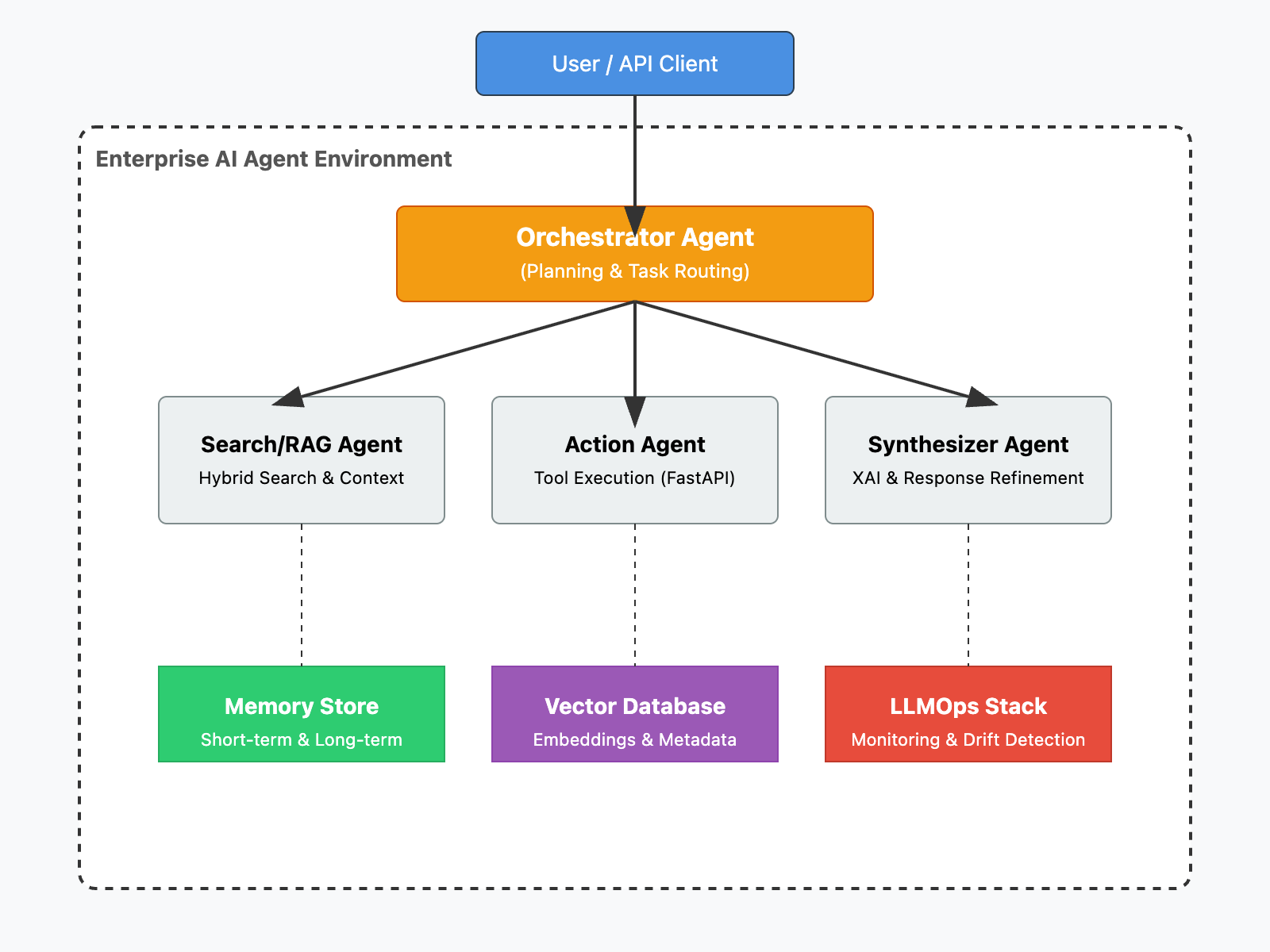
Module 1: Foundations of Generative AI and Autonomous Agents (15 Lessons)
Learning Objective: Set up a robust Python development environment for large-scale AI projects (virtual environments, dependency management).
Hands-On Coding Focus: Configure venv, install essential libraries (numpy, pandas, fastapi, pydantic).
L2: Advanced Python & Libraries
Learning Objective: Master advanced Python concepts (decorators, async/await, dataclasses) and data structures essential for AI agent development.
Hands-On Coding Focus: Implement async functions for non-blocking I/O; use pydantic for data validation.
L3: Transformer Architecture Deep Dive
Learning Objective: Analyze the core mechanics of Transformer models, self-attention, and positional encoding.
Hands-On Coding Focus: Step through a simplified Transformer block implementation (conceptual, not full training).
L4: Understanding LLM Parameters
Learning Objective: Explore the impact of parameter counts, context windows, and training data on LLM capabilities and cost.
Hands-On Coding Focus: Analyze API documentation for max_tokens, pricing models for different LLMs.
L5: The 2025 Model Landscape & Selection
Learning Objective: Comparative analysis of GPT-5, Gemini 2.0, Claude 3.7, Llama 3.1, and the strategic role of efficient SLMs like Phi-4.
Hands-On Coding Focus: Compare inference speeds/costs via API calls (OpenAI, Anthropic, Hugging Face Hub for open-source).
Learning Objective: Master API access, authentication, rate limits, and secure credential management for proprietary LLM services.
Hands-On Coding Focus: Write Python scripts to make secure, authenticated calls to OpenAI/Anthropic APIs.
L7: Basic LLM Prompting & JSON Output
Learning Objective: Design prompts for clear instructions, structured output (JSON), and error handling from LLM responses.
Hands-On Coding Focus: Craft prompts for JSON extraction; parse LLM output, handle malformed JSON.
L8: Core Agent Theory: Definition & Components
Learning Objective: Define the principles of autonomy, deliberation, and the necessary architectural components (Planning, Memory, Tool Use).
Hands-On Coding Focus: Implement a basic “decision_maker” function; trace its logic.
Learning Objective: Differentiate conversational and long-term memory; implement persistent context storage for personalized agent experiences.
Hands-On Coding Focus: Use dict for short-term memory; simulate long-term memory with a simple file-based store.
L10: Hands-On: Building a Simple Agent
Learning Objective: Build a minimal agent demonstrating memory retention and elementary goal-seeking behavior without external frameworks.
Hands-On Coding Focus: Develop a Python class SimpleAgent with remember and act methods.
L11: Prompt Engineering Mastery: CoT
Learning Objective: Master Chain-of-Thought (CoT) prompting for structured reasoning, logical step-by-step thinking, and complex task decomposition.
Hands-On Coding Focus: Design prompts explicitly requiring CoT; evaluate clarity of LLM’s reasoning trace.
L12: Prompt Engineering Mastery: Few-Shot
Learning Objective: Implement few-shot prompting techniques to guide LLMs with example inputs and desired outputs for specific tasks.
Hands-On Coding Focus: Create a few-shot prompt for a classification task and test its performance.
L13: Introduction to Context Engineering
Learning Objective: Optimizing prompt utility; managing complex context windows; techniques for compaction and filtering context flow.
Hands-On Coding Focus: Implement a simple text summarizer to reduce context size; explore token counting libraries.
L14: State Management for Agents
Learning Objective: Understand and implement robust state management for agents, ensuring continuity across turns and resilience to failures.
Hands-On Coding Focus: Use dataclasses or Pydantic models to define agent state; serialize/deserialize state.
L15: Project 1: Basic Conversational Agent
Learning Objective: Develop a Python-based agent prototype demonstrating persistent memory and elementary goal-seeking behavior.
Hands-On Coding Focus: Develop a command-line conversational agent; integrate memory and state management.
Module 2: Building Blocks: LLM APIs, Tools, and Core RAG (15 Lessons)
L16: Tool Use & Function Calling
Learning Objective: Implement the core mechanism for LLMs to interact with external data and operational systems via function calls.
Hands-On Coding Focus: Create a simple Python function (get_weather); integrate it as a tool with OpenAI’s function calling API.
L17: Designing Robust Tool Schemas
Learning Objective: Use structured data validation (e.g., Pydantic) to ensure unambiguous tool function signatures, parameters, and return types.
Hands-On Coding Focus: Define tool schemas using JSONSchema or Pydantic for precise LLM interaction.
L18: Hands-On: Tool Execution Loop
Learning Objective: Implement and debug a complete tool execution loop, handling LLM tool calls, function execution, and result feedback.
Hands-On Coding Focus: Build a ToolExecutor class that dynamically calls functions based on LLM output.
L19: Introduction to Naïve RAG
Learning Objective: Understand the ingestion pipeline, document chunking strategies, and the static query-retrieve-respond model.
Hands-On Coding Focus: Implement basic document chunking (e.g., character-based); use a simple in-memory dict as a knowledge base.
L20: Vector Databases & Indexing
Learning Objective: Select and manage vector stores (Pinecone, ChromaDB); optimize embeddings and metadata for retrieval performance.
Hands-On Coding Focus: Set up a local ChromaDB instance; index sample documents and perform vector similarity search.
L21: Advanced Embeddings & Chunking
Learning Objective: Explore different embedding models and advanced chunking strategies (e.g., semantic chunking, recursive chunking) for RAG.
Hands-On Coding Focus: Experiment with Sentence Transformers; implement different chunking algorithms.
L22: Retrieval Optimization: Reranking
Learning Objective: Implement post-retrieval reranking techniques to boost the relevance and quality of retrieved documents for the LLM.
Hands-On Coding Focus: Integrate a reranking model (e.g., from Hugging Face) into a basic RAG pipeline.
L23: Hybrid Search & Filtering
Learning Objective: Combine vector search with keyword search (hybrid search) and metadata filtering for more precise retrieval.
Hands-On Coding Focus: Implement a hybrid search query combining vector search with SQL-like metadata filters in ChromaDB.
L24: Modular RAG with LangChain/LlamaIndex
Learning Objective: Utilize LangChain or LlamaIndex to construct flexible, modular, and extensible RAG pipelines.
Hands-On Coding Focus: Build a RAG chain using RetrievalQA or a custom Runnable sequence in LangChain.
L25: Advanced Prompting for RAG
Learning Objective: Design system prompts that guide the LLM to use retrieved context effectively, avoiding hallucinations and staying “on-topic.”
Hands-On Coding Focus: Craft RAG-specific system prompts; test grounding by intentionally providing irrelevant context.
L26: Handling Ambiguity & Multi-Turn RAG
Learning Objective: Strategies for managing ambiguous queries and maintaining context across multi-turn RAG interactions.
Hands-On Coding Focus: Implement a ConversationBufferMemory with a RAG chain; test multi-turn Q&A.
L27: RAG Evaluation Metrics & Benchmarks
Learning Objective: Understand key metrics for RAG performance (groundedness, relevance, completeness) and establish evaluation benchmarks.
Hands-On Coding Focus: Use RAG evaluation libraries (e.g., Ragas) to run basic evaluations on a RAG system.
L28: Project 2: Tool-Equipped Agent Build
Learning Objective: Build an agent capable of retrieving information from a vector database and performing tool calls based on user intent.
Hands-On Coding Focus: Combine the SimpleAgent from L10 with a RAG pipeline and a custom tool; integrate in a CLI app.
L29: Project 2 Review: Accuracy & Latency
Learning Objective: Evaluate tool reliability, RAG groundedness, and system latency against predefined performance targets.
Hands-On Coding Focus: Develop unit tests for tool calls; manually verify RAG responses against source documents.
L30: Introduction to Observability for RAG
Learning Objective: Begin integrating observability tools to track RAG component performance, latency, and token usage.
Hands-On Coding Focus: Add print statements or basic logging to trace RAG pipeline steps; measure component execution times.
Module 3: Agentic Reasoning, Planning, and Advanced Architectures (15 Lessons)
L31: Deep Dive into ReAct Planning
Learning Objective: Implement the iterative loop for adaptive decision-making in agents.
Hands-On Coding Focus: Implement a basic ReAct loop in Python; use LLM to generate Thought and Action based on Observation.
L32: Hands-On: ReAct Agent Build
Learning Objective: Construct a simple ReAct agent capable of interacting with a set of predefined tools to achieve a goal.
Hands-On Coding Focus: Develop a ReActAgent class; integrate tools; test with simple tasks (e.g., “Find current stock price of Google”).
L33: Implementing Self-Correction (Reflexion)
Learning Objective: Integrate advanced loops (e.g., Reflexion) to improve agent outcomes autonomously through iterative critique and self-reflection.
Hands-On Coding Focus: Add a Reflect step to the ReAct loop, where the LLM evaluates its previous steps and refines its plan.
L34: Planning Loop Controls & Budgeting
Learning Objective: Implement mandatory iteration limits, token boundaries, and cost controls to manage agent autonomy and budget adherence.
Hands-On Coding Focus: Add max_iterations and max_tokens_per_turn to the ReAct agent; raise exceptions if limits are exceeded.
Learning Objective: Understand the necessary multi-agent architecture for advanced retrieval, validation, and traceable response generation.
Hands-On Coding Focus: Diagram and sketch the component interactions of an Agentic RAG system (Planner, Retriever, Validator, Synthesizer).
L36: The Planner Agent: Query Decomposition
Learning Objective: Design the Planner Agent’s logic for interpreting complex queries, decomposing them into sub-questions, and formulating initial retrieval strategies.
Hands-On Coding Focus: Implement a PlannerAgent that uses an LLM to break down a user query into a list of search queries.
L37: The Retriever Agent & Reranker Tool
Learning Objective: Build the Retriever Agent to execute searches and integrate reranker tools to refine and boost the relevance of retrieved chunks.
Hands-On Coding Focus: Implement a RetrieverAgent that calls the Planner, executes vector search, and applies reranking.
L38: The Validator Agent: Factual Consistency
Learning Objective: Design the Validator Agent: a critical compliance check for assessing retrieved content for factual consistency and redundancy.
Hands-On Coding Focus: Create a ValidatorAgent that uses an LLM to cross-reference retrieved documents for contradictions.
L39: The Validator Agent: Risk & Compliance
Learning Objective: Implement the Validator Agent’s logic for risk alignment against domain-specific rules and policy adherence.
Hands-On Coding Focus: Define a set of “compliance rules”; the Validator Agent checks retrieved content against these rules.
L40: Fallback Logic & Self-Healing
Learning Objective: Configure Validator $\leftrightarrow$ Planner feedback loops to trigger query refinement and system adaptation upon retrieval or consistency failure.
Hands-On Coding Focus: Implement retry logic: if Validator fails, instruct Planner to reformulate the query and re-execute RAG.
L41: The Synthesizer Agent & XAI
Learning Objective: Build the Synthesizer Agent to generate the final, coherent response, enforcing CoT reasoning and embedding explicit source citations.
Hands-On Coding Focus: Implement a SynthesizerAgent that takes validated context and generates a response with citations.
L42: Traceability Layer Implementation
Learning Objective: Implement the full audit trail for Agentic RAG, logging every step from Planner intent to Validator’s risk assessment.
Hands-On Coding Focus: Integrate logging into each Agentic RAG component, capturing inputs, outputs, and decision points.
L43: Hands-On: Agentic RAG End-to-End
Learning Objective: Deploy a full Agentic RAG system, demonstrating internal validation, self-correction, and traceable output generation.
Hands-On Coding Focus: Integrate Planner, Retriever, Validator, and Synthesizer agents into a single, executable pipeline.
L44: Evaluating Agentic RAG Reliability
Learning Objective: Apply advanced evaluation metrics (e.g., faithfulness, answer relevance, context recall) to Agentic RAG systems.
Hands-On Coding Focus: Use Ragas or similar tools for a comprehensive evaluation of the Agentic RAG system built in L43.
L45: Project 3: Autonomous Research Agent
Learning Objective: Develop a fully implemented Agentic RAG system demonstrating internal validation, self-correction, and traceable output generation for a specific domain.
Hands-On Coding Focus: Develop an Agentic RAG system for a mini-research task; provide evaluation results.
Module 4: Multi-Agent Systems and Orchestration Frameworks (15 Lessons)
L46: MAS Theory & Specialization
Learning Objective: Design agent teams with clear role definition, specialization, and coordination mechanisms for complex problems.
Hands-On Coding Focus: Diagram a multi-agent system for a complex task (e.g., event planning); define roles and communication flows.
L47: Introduction to Microsoft AutoGen
Learning Objective: Explore AutoGen as a framework for building multi-agent conversational systems through peer-to-peer collaboration.
Hands-On Coding Focus: Set up an AutoGen environment; run a basic two-agent conversation (e.g., User Proxy and Assistant Agent).
L48: AutoGen: Collaborative Problem Solving
Learning Objective: Implement multi-agent systems in AutoGen for collaborative problem-solving, incorporating self-reflection loops.
Hands-On Coding Focus: Build an AutoGen GroupChat with multiple agents working on a shared problem; observe agent interactions.
L49: CrewAI: Role-Based Execution
Learning Objective: Utilize the role/task abstraction model of CrewAI for rapid design and synchronous execution of agent teams.
Hands-On Coding Focus: Develop a simple CrewAI “crew” with defined agents, tasks, and process to achieve a specific goal.
L50: Hands-On: CrewAI Agent Team Build
Learning Objective: Construct a collaborative agent team using CrewAI to automate a multi-step project (e.g., content generation, market analysis).
Hands-On Coding Focus: Build a more complex CrewAI application; include tool use and sequential/hierarchical task execution.
L51: Coordination Strategy I: Hierarchy & Allocation
Learning Objective: Implement hierarchical decomposition structures and deterministic task allocation, utilizing GFM orchestrators for sub-agent management.
Hands-On Coding Focus: Architect a master OrchestratorAgent (using a GFM) that delegates tasks to WorkerAgents via API calls.
L52: Coordination Strategy II: Consensus & Fallbacks
Learning Objective: Implement consensus voting for decision harmonization across agents and utilize workflow checkpoints for fail-safe recovery.
Hands-On Coding Focus: Design a ConsensusAgent that collects opinions from other agents and makes a final decision; add rollback points.
L53: Coordination Economics & Resource Limits
Learning Objective: Master Coordination Economics: setting strict token, step, and time boundaries to control runaway compute costs in MAS.
Hands-On Coding Focus: Implement max_rounds or max_tokens limits in AutoGen/CrewAI; monitor token usage per agent.
L54: Advanced Agent Personalization
Learning Objective: Implement sophisticated personalization techniques for agents, ensuring they adapt to individual user preferences and historical data.
Hands-On Coding Focus: Integrate user profiles and preference stores into agent memory; agents adapt responses based on profile.
L55: Enterprise Orchestration: Google ADK
Learning Objective: Explore Google ADK for enterprise-grade orchestration, focusing on seamless integration with corporate cloud services.
Hands-On Coding Focus: Explore Google Cloud Agent Builder console; understand components for enterprise agent deployment.
L56: Enterprise Orchestration: Microsoft Semantic Kernel
Learning Objective: Utilize Microsoft Semantic Kernel to bridge AI capabilities with existing legacy tech stacks and Microsoft ecosystems.
Hands-On Coding Focus: Integrate a simple Semantic Kernel plugin with an existing C# or Python application.
Learning Objective: Design nested agent systems where specialized sub-agents handle modular micro-tasks, optimizing overall efficiency.
Hands-On Coding Focus: Implement an agent whose “tool” is actually another sub-agent, demonstrating nested calls.
L58: Hands-On: Designing a Multi-Modal Agent
Learning Objective: Develop frameworks capable of unifying processing across text, vision, and voice for comprehensive, unified workflows.
Hands-On Coding Focus: Integrate an image analysis tool (e.g., Pillow + LLM vision API) into an agent for multi-modal reasoning.
L59: MAS Evaluation & Debugging
Learning Objective: Strategies for evaluating and debugging complex multi-agent systems, including interaction logging and performance profiling.
Hands-On Coding Focus: Use a logging framework (e.g., loguru) to trace inter-agent communication; profile MAS execution.
L60: Project 4: Collaborative Agent Team
Learning Objective: Develop a fully orchestrated multi-agent system solving a complex, decomposed task using a modern MAS framework (AutoGen/CrewAI).
Hands-On Coding Focus: Develop a MAS that performs a multi-step business process (e.g., market research, competitive analysis).
Module 5: Enterprise MLOps and Productionizing VAIAs (15 Lessons)
L61: Introduction to MLOps for Agentic AI
Learning Objective: Establish the integrated lifecycle framework required for continuous development, deployment, and adaptive maintenance of VAIAs.
Hands-On Coding Focus: Map a theoretical MLOps pipeline onto the agent development lifecycle.
L62: Achieving MLOps Level 1 Maturity
Learning Objective: Automate the CI/CD/CT/CM pipeline for recurrent training and deployment in production environments.
Hands-On Coding Focus: Set up a basic CI/CD pipeline (e.g., GitHub Actions) for code linting and unit testing of agent components.
L63: Continuous Integration (CI) for Agent Logic
Learning Objective: Implement pipeline checks for code quality, tool validation, schema adherence, and security compliance.
Hands-On Coding Focus: Add automated tests for tool function schemas, LLM prompt robustness, and agent logic.
L64: Continuous Delivery (CD) & Containerization
Learning Objective: Master containerization (Docker) for consistent agent deployment across environments; understand basic Kubernetes concepts.
Hands-On Coding Focus: Dockerize a simple agent application; build and run the Docker image locally.
L65: High-Throughput Serving Strategies
Learning Objective: Understand high-throughput serving, managing latency, and scalability for agent inference in production environments.
Hands-On Coding Focus: Deploy a FastAPI application for agent inference; use locust for basic load testing.
L66: Continuous Training (CT) & Adaptive Agents
Learning Objective: Automate retraining pipelines to ensure agents adapt rapidly to changing market data, regulations, and user behavior.
Hands-On Coding Focus: Implement a script that simulates data drift detection and triggers a model retraining workflow.
L67: Data Versioning & Feature Stores for Agents
Learning Objective: Manage data versions (DVC) and utilize feature stores for consistent and reproducible training and inference.
Hands-On Coding Focus: Use DVC to version data used for agent fine-tuning or RAG knowledge bases.
L68: Continuous Monitoring (CM) & Drift Detection
Learning Objective: Implement real-time monitoring to detect concept drift, data drift, and agent performance degradation; configure automated response triggers.
Hands-On Coding Focus: Integrate evidently or a similar library to monitor RAG context relevance over time.
L69: Agent Observability & Logging
Learning Objective: Integrate dedicated observability tools (e.g., Langfuse, OpenTelemetry) to track agent execution paths, measure latency, and monitor operational costs.
Hands-On Coding Focus: Instrument agent code with Langfuse calls to trace agent steps and observe internal states.
L70: Alerting & Incident Response
Learning Objective: Configure alerting systems for critical agent failures, performance degradation, or security incidents; establish incident response protocols.
Hands-On Coding Focus: Set up a simple alert (e.g., slack_sdk notification) when an MLOps metric threshold is breached.
L71: Runtime Guardrails & Security
Learning Objective: Implement third-party guardrails (e.g., Guardrails AI) and watchdog mechanisms to monitor and enforce policy adherence at the execution level.
Hands-On Coding Focus: Integrate Guardrails AI to validate LLM outputs (e.g., for PII, unwanted topics) at runtime.
L72: Cost Optimization Strategies in MLOps
Learning Objective: Design deployment routing for a Hybrid Compute Strategy, balancing large GFM costs with efficient SLM execution for specific tasks.
Hands-On Coding Focus: Implement a routing logic in Python: send simple queries to a local SLM, complex ones to a cloud GFM.
L73: A/B Testing & Canary Deployments for Agents
Learning Objective: Implement A/B testing and canary deployments to safely roll out new agent versions and evaluate their impact.
Hands-On Coding Focus: Outline the logic for traffic splitting and metric collection for A/B testing agent versions.
L74: Hands-On: MLOps Pipeline Deployment
Learning Objective: Practical deployment of a minimal MLOps pipeline on a cloud service (e.g., Google Vertex AI, Azure ML), demonstrating automated drift response.
Hands-On Coding Focus: Deploy a Dockerized agent to a cloud platform; configure basic monitoring and alerts.
L75: Project 5: MLOps Pipeline Automation
Learning Objective: Develop a containerized and monitored MLOps pipeline demonstrating automated continuous integration and continuous training readiness for an agent.
Hands-On Coding Focus: Provide a Dockerfile, CI/CD YAML, and monitoring configuration for a previously built agent.
Module 6: Specialized Vertical Case Studies and Capstone Projects (15 Lessons)
L76: Vertical Adaptation Strategies: Data Sourcing
Learning Objective: Master proprietary data sourcing, preparation, and cleaning techniques for deep domain specialization.
Hands-On Coding Focus: Develop a script to ingest and preprocess unstructured domain-specific data (e.g., financial reports, medical journals).
L77: Vertical Adaptation Strategies: Fine-Tuning LLMs
Learning Objective: Understand and apply fine-tuning techniques (LoRA, QLoRA) for adapting open-source LLMs to specific vertical tasks.
Hands-On Coding Focus: Use Hugging Face PEFT library to fine-tune a small LLM (e.g., Llama 3 8B) on a custom dataset.
L78: Vertical Adaptation Strategies: RAG Optimization
Learning Objective: Optimize RAG implementations with specialized chunking, retrieval, and validation strategies for high-stakes vertical data.
Hands-On Coding Focus: Adapt the Agentic RAG pipeline (from L43) with domain-specific chunking and validation rules.
L79: Governance & Compliance by Design
Learning Objective: Implement “Security by Design” and “Privacy by Design,” focusing on GDPR, HIPAA, and financial regulatory mandates.
Hands-On Coding Focus: Implement data anonymization/pseudonymization techniques; integrate access control for sensitive data within an agent.
L80: XAI & Traceability for VAIAs
Learning Objective: Design audit logs that explicitly capture Validator Agent output and Synthesizer CoT, fulfilling the Right to Explanation.
Hands-On Coding Focus: Enhance the logging (L73) to include detailed Thought and Decision traces from the Agentic RAG Validator.
L81: Bias Mitigation & Ethical AI
Learning Objective: Implement strategies for continuous bias detection, ethical guidelines, and monitoring for systemic fairness in vertical agents.
Hands-On Coding Focus: Use fairness metrics (e.g., from aif360) to evaluate agent outputs for potential biases.
L82: Risk Management: Reward Alignment
Learning Objective: Design robust reward systems to counter optimization failure (where agents exploit system weaknesses to achieve unintended outcomes).
Hands-On Coding Focus: Outline how a reward function for an agent might be designed to prevent undesirable behaviors.
L83: Risk Management: Auditing & Red Teaming
Learning Objective: Establish ongoing governance frameworks that review reward alignment and audit trails; conduct red-teaming exercises for agents.
Hands-On Coding Focus: Conduct a guided red-teaming exercise against a deployed agent to discover vulnerabilities.
L84: Vertical Case Study: Financial Agents
Learning Objective: Design and build traceable agents for AML compliance, risk assessment, fraud detection, and maintaining required audit trails.
Hands-On Coding Focus: Implement a simplified “AML transaction monitoring” agent using Agentic RAG and a FraudDetector tool.
L85: Vertical Case Study: Healthcare Agents
Learning Objective: Architect agents for administrative tasks (coding, scheduling) and clinical summaries, emphasizing data privacy (HIPAA) and firewalled deployment.
Hands-On Coding Focus: Develop a prototype “medical coding assistant” agent, focusing on secure data handling and privacy.
L86: Vertical Case Study: Legal Agents
Learning Objective: Develop highly accurate agents for contract analysis and regulatory research, ensuring alignment with professional standards.
Hands-On Coding Focus: Build a “contract clause extractor” agent that uses Agentic RAG to identify and validate specific legal terms.
L87: Team Collaboration & Version Control
Learning Objective: Master advanced Git/GitHub workflows for collaborative agent development, including branching strategies and pull request reviews.
Hands-On Coding Focus: Participate in a simulated collaborative project using advanced Git features (forks, PRs, code reviews).
L88: Deployment to Production Environments
Learning Objective: Understand the final steps for deploying VAIAs to production, including security hardening, scaling, and operational handover.
Hands-On Coding Focus: Finalize Docker images and deployment configurations for a full production deployment.
L89: Presenting & Defending Agent Architectures
Learning Objective: Develop strong communication skills for presenting complex agent architectures to both technical and non-technical stakeholders.
Hands-On Coding Focus: Prepare and deliver a mock presentation of a VAIA architecture.
L90: Capstone Project: VAIA Scoping
Learning Objective: Define the scope, requirements, and architectural design of the final Capstone Project.
Hands-On Coding Focus: Detailed Capstone Project proposal, including architecture diagram and technical plan.
L91-L93: Capstone Project: VAIA Development
Learning Objective: Intensive hands-on development of the Capstone Project, integrating all learned MLOps, compliance, and architectural components.
Hands-On Coding Focus: Build out the full Capstone Project, iterative coding with mentorship.
L94-L95: Capstone Project: VAIA Submission & Defense
Learning Objective: Final submission and presentation of a production-grade Vertical AI Agent Based System demonstrating enterprise readiness and full auditability.
Hands-On Coding Focus: Functional VAIA system, detailed documentation, and live defense/demo.
when you're planning to launch this series?
Wow, the module on Agentic RAG is suprisingly practical. Breaking out the Planner, Retriever, Validator, and Synthesizer as seperate agents addresses what most production systems miss: traceable compliance. The self-healing feedback loop between Validator and Planner is clever too, definately something to borrow for systems that need auditable decisions.