[A] Today’s Build
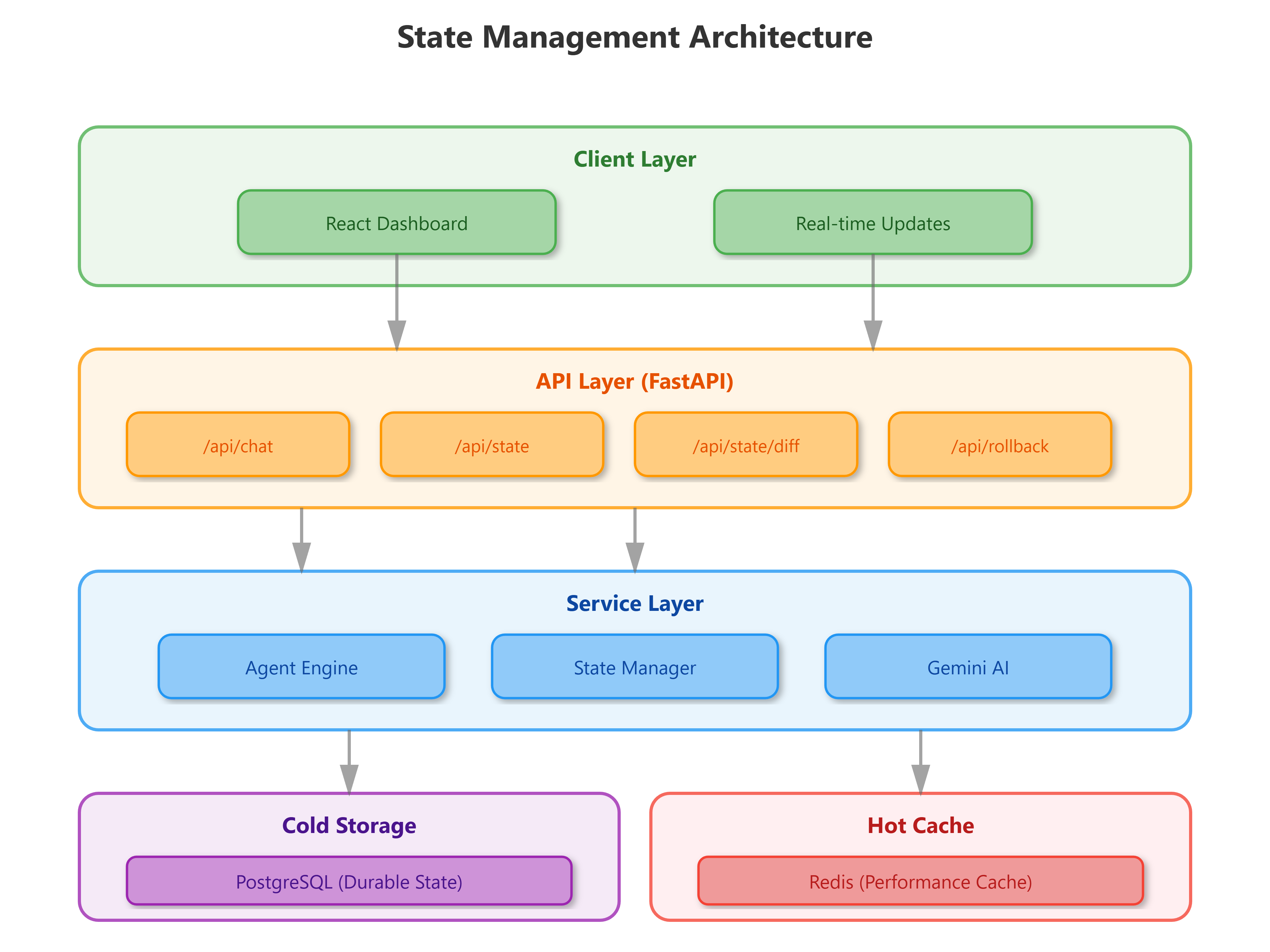
We’re building a production-grade state management system for AI agents that handles:
Typed state models using Pydantic with validation and serialization
State persistence layer with PostgreSQL and Redis for hot/cold storage
State versioning system tracking agent decision history across conversations
Failure recovery mechanisms enabling agents to resume from checkpoints
State migration engine handling schema evolution without data loss
This builds directly on L13’s context engineering by adding stateful memory - while L13 taught us to compress context intelligently, L14 ensures that compressed state persists reliably across agent lifecycles. The context summarizer from L13 becomes a component in our state snapshot system.
This enables L15’s conversational agent by providing the infrastructure for maintaining user preferences, conversation history, and goal tracking across sessions.
[B] Architecture Context
L14 sits at a critical juncture in our 90-lesson VAIA path - we’re transitioning from stateless prompt engineering (L1-L13) to stateful agent systems (L14-L30). This lesson forms the foundation for all subsequent agent architectures.
Integration with L13 is direct: we reuse the TokenCounter and ContextSummarizer to create compact state snapshots. Where L13 handled single-turn context optimization, L14 adds multi-turn persistence with versioning and recovery.
Module 3 (Agent Foundations, L14-L20) builds autonomous systems. L14 provides the state substrate; L15 adds conversation logic; L16 introduces goal planning; L17 adds tool integration. Each layer assumes robust state management.