What We Build:
Hard iteration limits on ReAct planning loops preventing runaway agent execution
Token-per-turn budgets with real-time tracking and enforcement across LLM calls
Cost monitoring dashboard showing per-request token usage and cumulative spend
Exception-based circuit breakers that halt agents exceeding defined boundaries
Configurable budget policies supporting development, staging, and production environments
Building on L33 (Self-Correction/Reflexion): L33 introduced iterative self-improvement through Reflexion loops where agents critique and refine their reasoning. While powerful, unbounded reflection creates two critical production risks: agents can iterate indefinitely consuming excessive compute, and self-correction loops can spiral into costly token exhaustion. L34 wraps these capabilities with mandatory controls that preserve autonomy within safe operational boundaries.
Enables L35 (Agentic RAG): Agentic RAG systems coordinate multiple specialized agents (Planner, Retriever, Validator, Synthesizer), each executing their own planning loops. Without granular budgeting at the agent level, a single misbehaving component can exhaust resources for the entire system. L34’s per-agent budget tracking and hierarchical limit enforcement become foundational for multi-agent architectures where cost accountability and resource isolation are non-negotiable.
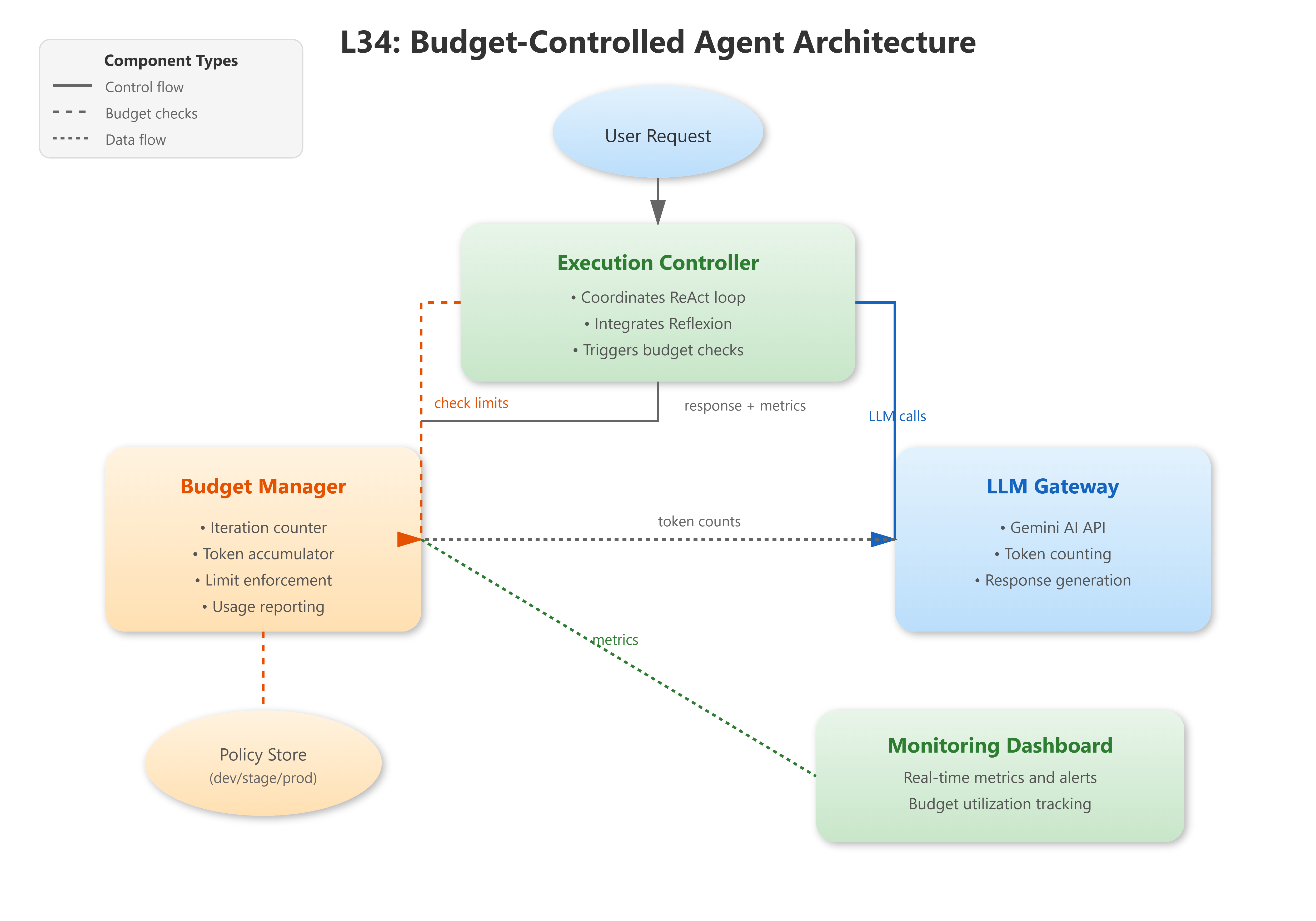
The architecture diagram shows BudgetManager as a stateful component receiving token counts from LLM Gateway, exposing limit checks to ExecutionController, and publishing metrics to the monitoring dashboard.