Highlights
What we build:
A persistent
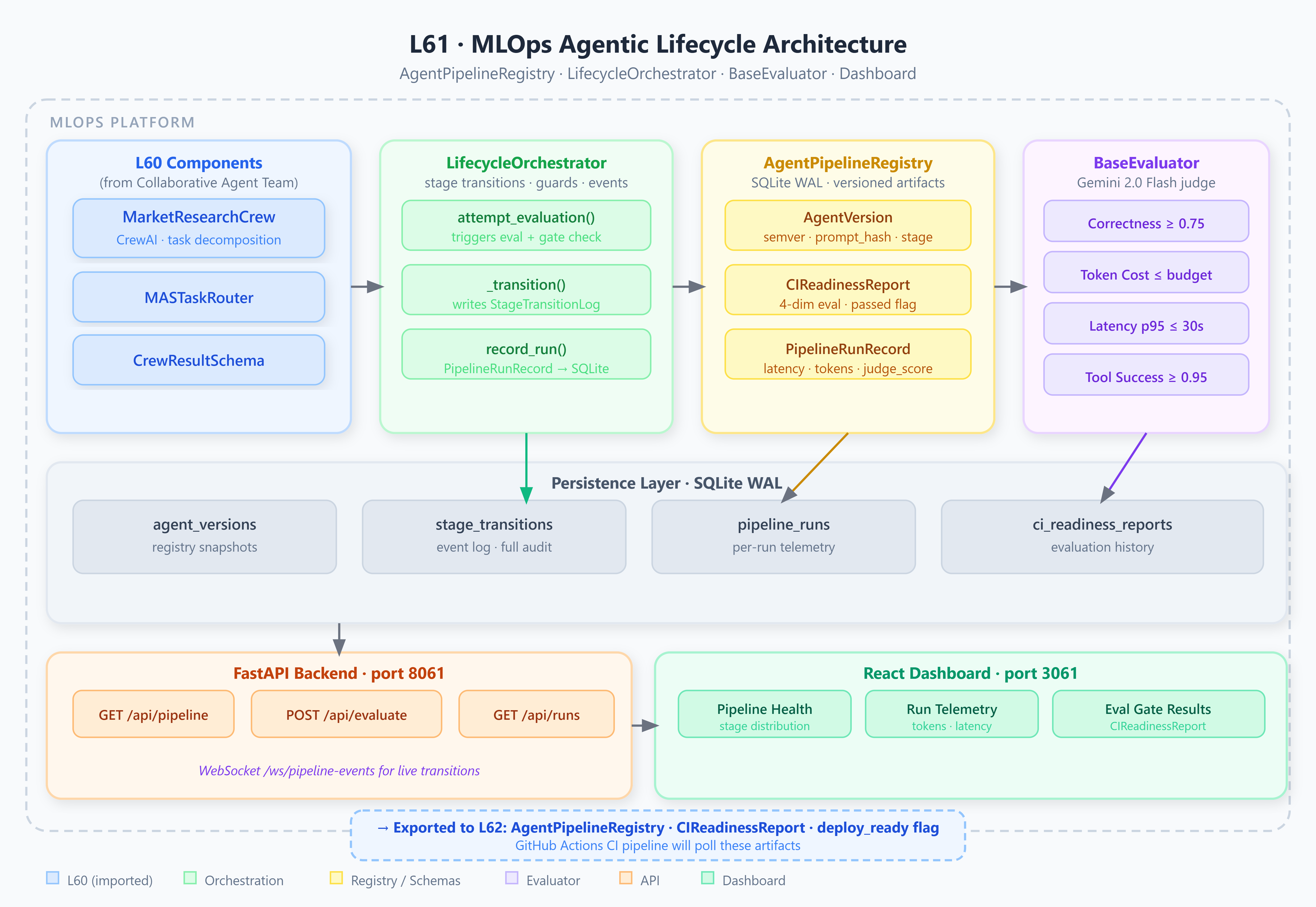
AgentPipelineRegistrythat tracks every agent variant through defined lifecycle stagesA
StageTransitionLogcapturing timestamps, triggers, and evaluation scores at each stage gateA
PipelineRunRecordstoring inputs, outputs, latency, token cost, and drift signals per runA
LifecycleOrchestratorthat drives the L60MarketResearchCrewthrough the full MLOps loopA React dashboard visualising pipeline health, stage distribution, and run telemetry in real time
Connection to L60: The
MarketResearchCrewandCrewResultSchemafrom L60 become the subject under management. L61 wraps them in a lifecycle harness; every crew run is now aPipelineRunRecordwith evaluation, versioning, and transition logic attached.
Enables L62: The
AgentPipelineRegistry,BaseEvaluatorinterface, andCIReadinessReportschema exported here are the exact inputs L62’s GitHub Actions pipeline will consume to automate continuous training and deployment gates.
Architecture Context
Place in the 90-lesson arc
Lessons 1–60 built the agent stack bottom-up: foundations, memory, RAG, multi-agent orchestration. Module 5 pivots to operations — the discipline that keeps production agents reliable, measurable, and improvable. L61 is the conceptual anchor: it establishes the vocabulary, schemas, and instrumentation layer that every subsequent Module 5 lesson extends.
Integration with L60 components
L60 Output                   L61 Role
─────────────────────────────────────────────────────
MarketResearchCrew           Subject under management
CrewResultSchema             Evaluated artifact
MASTaskRouter                Stage-transition trigger
SQLite task log              Extended to PipelineRunRecord
Module 5 objectives
Module 5 covers the full MLOps maturity ladder for agents: lifecycle framing (L61), CI/CD automation (L62), experiment tracking (L63), canary deployment (L64), drift detection (L65), and feedback-loop closure (L66–L75). L61 defines the shared data model all subsequent lessons read and write.