Highlights
What we build:
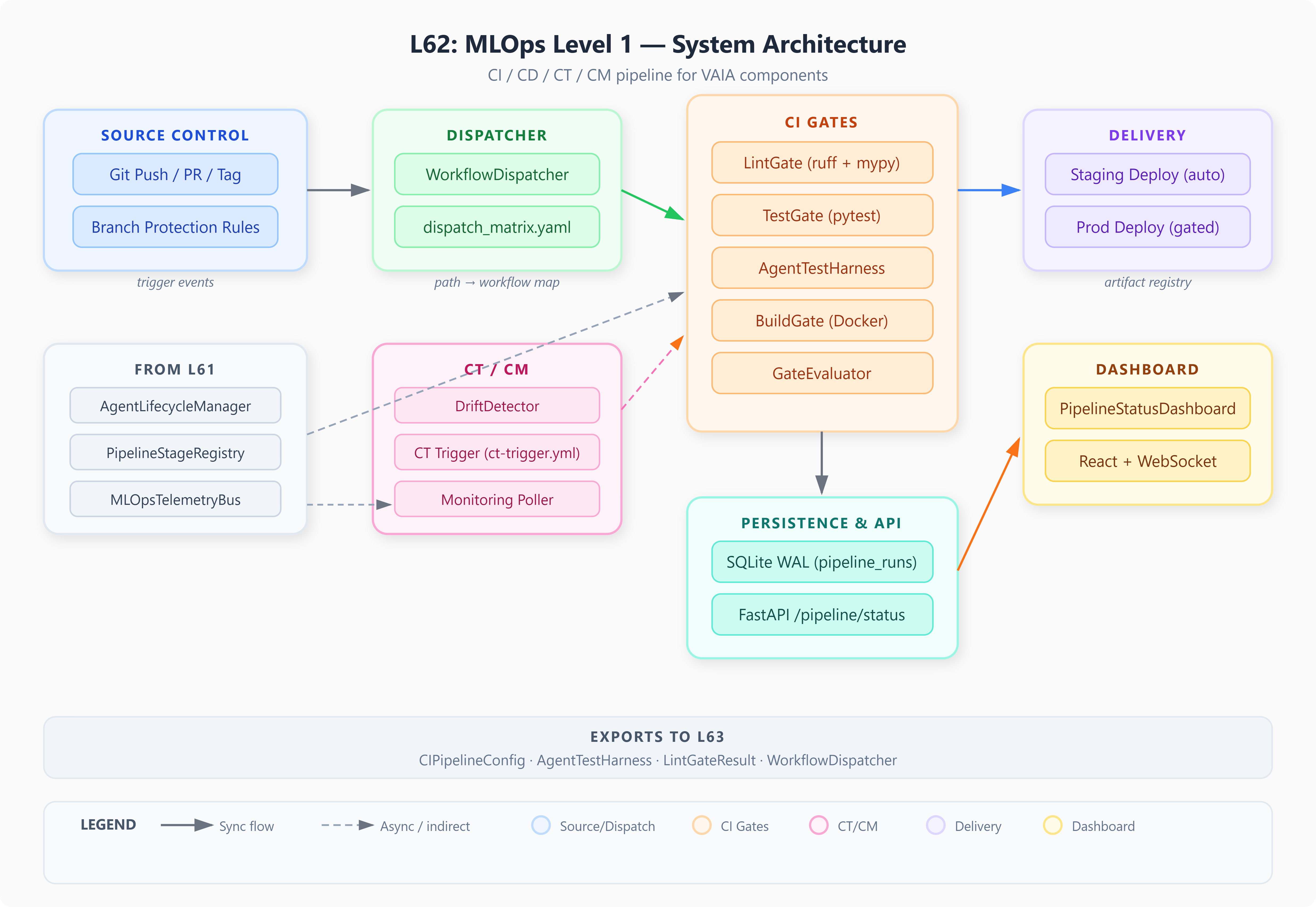
A GitHub Actions CI workflow with multi-stage gates: lint, type-check, unit tests, and coverage threshold enforcement
An
AgentTestHarnessthat validates tool function schemas, prompt templates, and memory interfaces from L61’sPipelineStageRegistryA
WorkflowDispatcherthat maps Git events (push, PR, tag) to the correct pipeline stageA
PipelineStatusDashboardReact frontend consuming a FastAPI/pipeline/statusendpoint backed by SQLite WALA continuous training (CT) trigger stub that fires when evaluation drift thresholds are crossed — the foundation for L63’s schema-aware CI gates
Connection to L61: L61 gave us the
AgentLifecycleManager,PipelineStageRegistry, andMLOpsTelemetryBus. This lesson wraps those components in automated quality gates. Every stage registered inPipelineStageRegistrynow has a corresponding CI check that must pass before the stage is allowed to advance. TheDeploymentManifestfrom L61 becomes the contract that lint and schema validators enforce.
Enables L63: The
CIPipelineConfigandAgentTestHarnessproduced here are the extensibility points L63 needs to add tool-function schema validation, LLM prompt robustness checks, and structured security compliance scans.
Architecture Context
Place in the 90-lesson path: Module 5 (L58–L72) systematically industrializes what Module 4 (autonomous multi-agent systems) built. L61 established the conceptual MLOps lifecycle; L62 operationalizes it at Level 1 maturity — the first rung at which a VAIA team can honestly claim “we have automation.” L63 deepens that CI layer with agent-specific semantic checks. By L65, we will have a complete CT loop with drift detection and scheduled retraining.
MLOps Maturity Model applied to VAIAs:
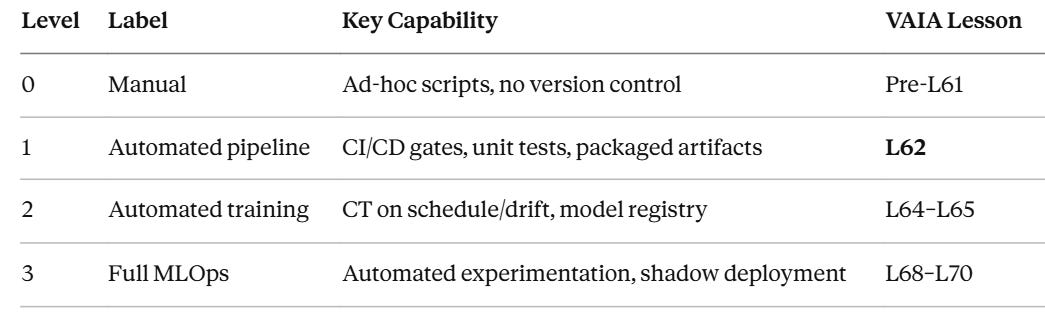
Level 1 is the most impactful jump. Teams stuck at Level 0 spend 60–80% of their effort on integration friction. Reaching Level 1 reclaims that bandwidth for actual agent improvements.
Integration with L61 components: AgentLifecycleManager.advance_stage() is now gated behind LintGateResult.passed == True. MLOpsTelemetryBus receives pipeline events, making CI outcomes observable alongside runtime metrics.