
A. Highlights
What we build:
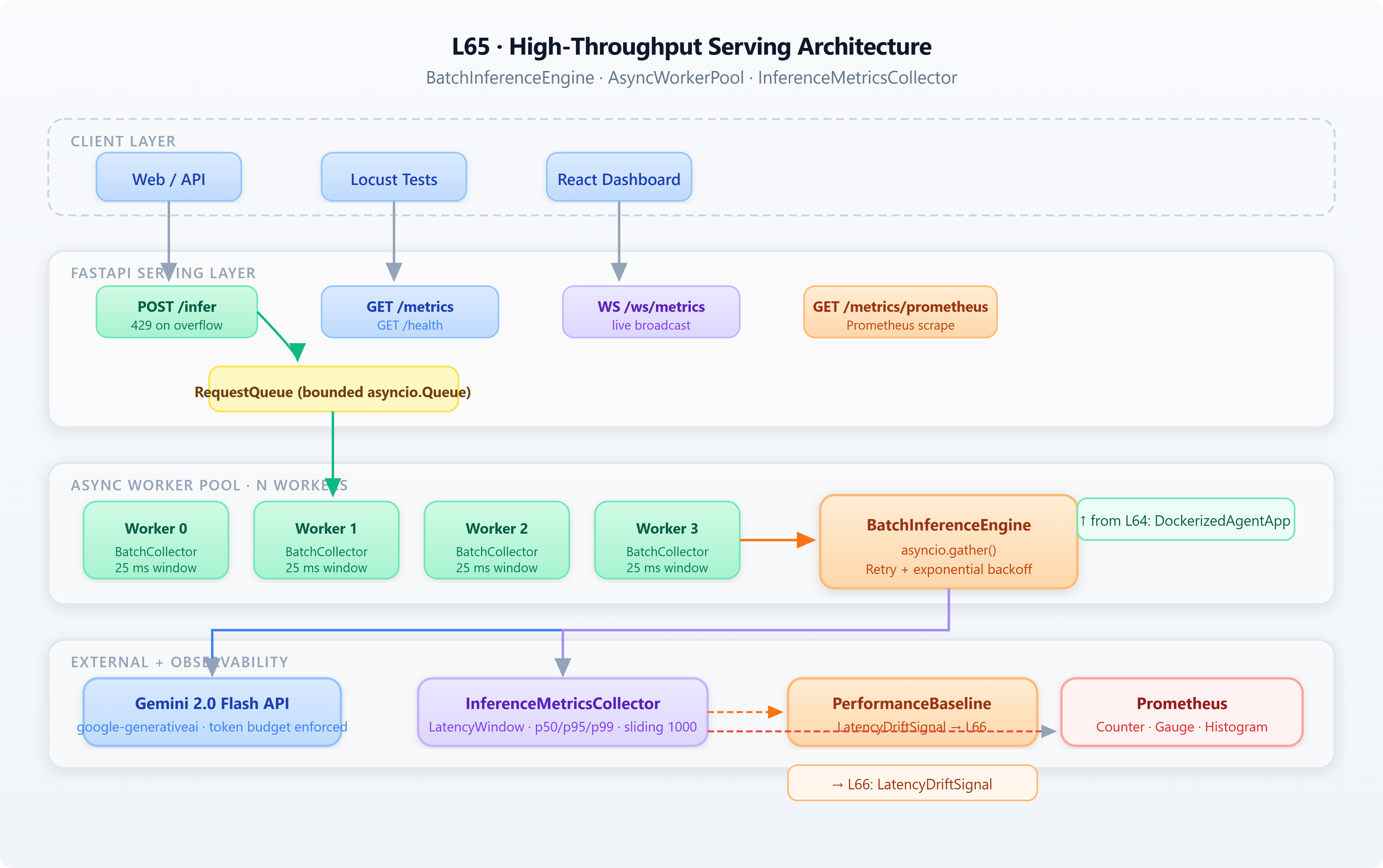
A production FastAPI inference server with dynamic batching, async worker pools, and explicit backpressure signaling
A
BatchInferenceEnginethat groups concurrent agent requests into Gemini API calls, amortizing per-request overheadAn
InferenceMetricsCollectorstreaming p50/p95/p99 latency, queue depth, and tokens-per-second to a live React dashboardA Locust load test suite that characterizes throughput curves and surfaces the exact queue-depth inflection point where latency degrades
A
PerformanceBaselinesnapshot exported for L66’s drift detection pipeline
Connection to L64: L64 produced a
DockerizedAgentApp— a containerized FastAPI service with a health endpoint. This lesson takes that container and turns it into a throughput-engineered serving layer. TheDockerfileanddocker-compose.ymlfrom L64 are extended directly; no rebuild from scratch.
Enables L66: L66 needs a signal that the model has drifted. The LatencyDriftSignal and PerformanceBaseline produced here give L66 exactly that: a statistical fingerprint of healthy-state latency that the next lesson’s retraining pipeline monitors for deviation.
B. Architecture Context
Place in the 90-lesson path: Lessons L61–L65 form the operationalization spine of Module 5. L61 covered monitoring, L62 alerting, L63 CI pipelines, L64 containerization. L65 is the performance engineering capstone of this group. Everything before it was about getting the agent running reliably; L65 is about getting it running fast, at scale, under realistic load.
Integration with L64 components: The ContainerEntrypoint from L64 (entrypoint.sh) is reused verbatim. The AgentHealthCheck endpoint is extended with a /metrics route. The docker-compose.yml gains a locust service using the official locustio/locust image.
Module 5 objective alignment: Module 5 targets production-readiness across five axes: observability, delivery, performance, adaptability, and cost. L65 owns performance entirely. The ThroughputMonitor and InferenceMetricsCollector built here feed directly into L66’s adaptability axis.
Preparing for a distributed systems interview?
→Download the free Interview Pack
→ Subscribe now to access source code repository - 200 + coding lessons
