
[A] Today’s Build
We’re building a Production-Grade Prompt Engineering System that transforms LLM outputs into reliable, structured data:
Smart Prompt Constructor - Dynamic prompt templating with validation
JSON Parser Pipeline - Multi-strategy parsing with fallback recovery
Error Recovery Dashboard - Real-time monitoring of parse failures and auto-corrections
Structured Response Validator - Schema enforcement with confidence scoring
Building on L6: We extend the secure API client from L6 with intelligent prompt engineering and robust JSON extraction, turning raw LLM responses into production-ready structured data.
Enabling L8: This lesson provides the foundation for agent decision-making by ensuring LLMs return structured, parseable outputs that agents can reason over.
[B] Architecture Context
In the 90-lesson VAIA curriculum, L7 sits at a critical juncture where we transition from basic LLM interaction (L6) to autonomous agent behavior (L8). Module 1 focuses on LLM foundations—L7 specifically bridges the gap between raw text generation and structured agent reasoning.
Integration with L6: We leverage the authenticated API client, rate limiting, and retry logic from L6, adding a parsing layer that converts text responses into actionable data structures.
Module Objectives Alignment: By the end of Module 1, students will have a complete LLM interaction pipeline. L7 completes the “output transformation” piece, ensuring agents receive structured data rather than unpredictable text.
Component Architecture
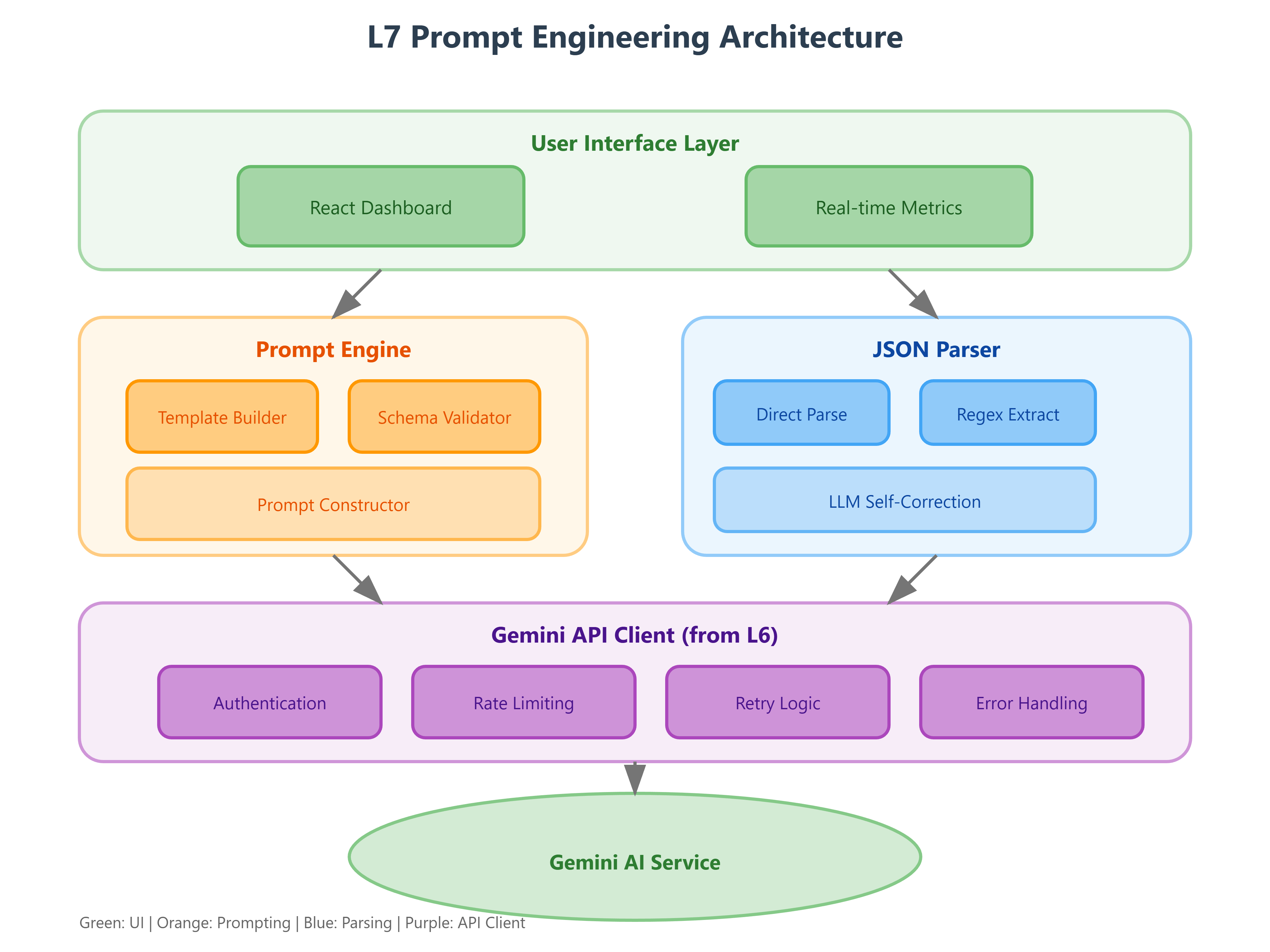
Our system consists of four primary components:
PromptEngine - Manages templates, injects variables, validates structure
GeminiClient - Extended from L6 with schema-aware requests
JSONParser - Multi-strategy extraction with confidence scoring
ValidationPipeline - Pydantic schemas + business rule checks
Data flows from user requests → prompt construction → LLM API call → multi-tier parsing → validated output → agent consumption.
