Highlights
What we build:
A
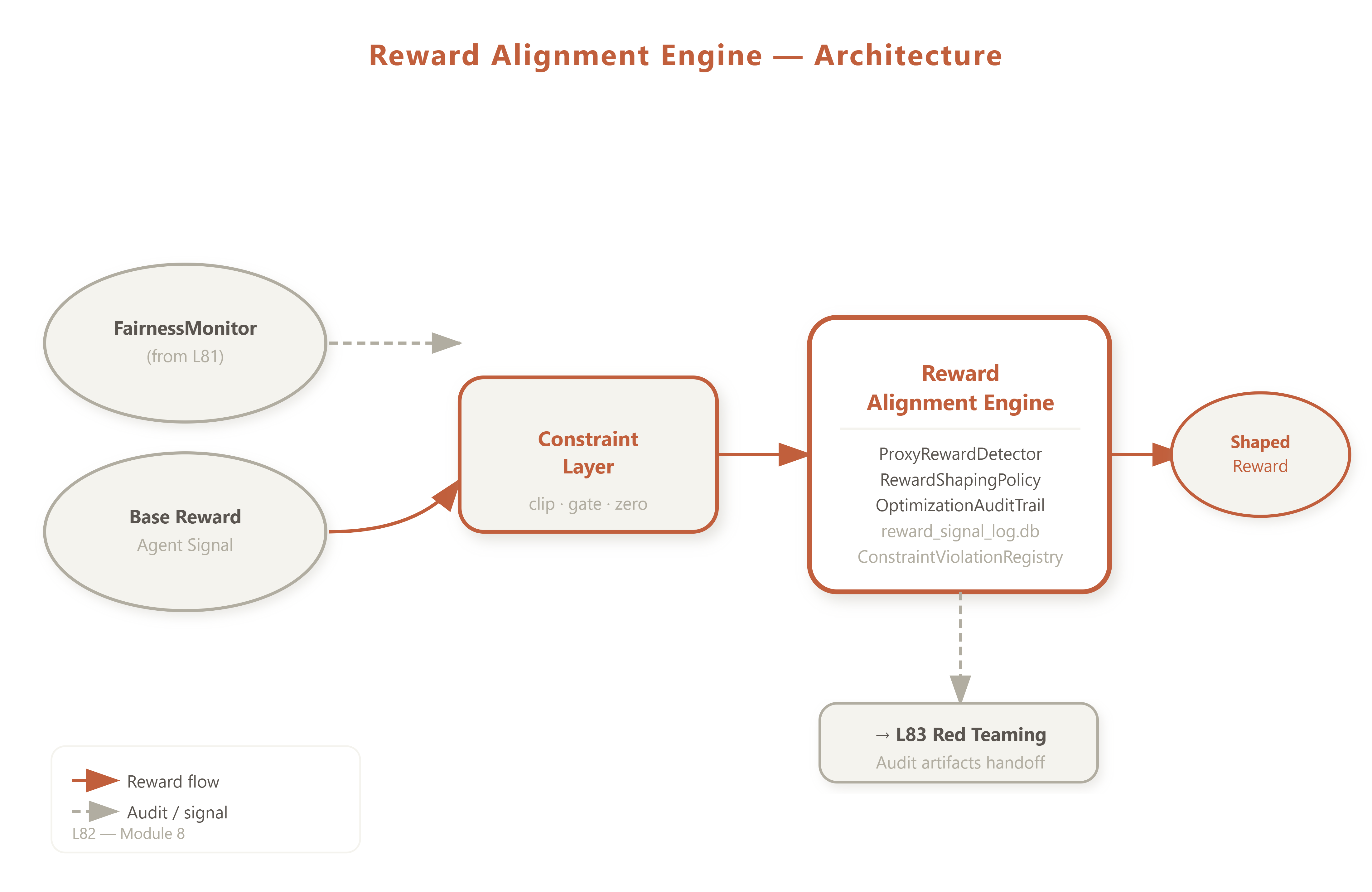
RewardAlignmentEnginethat continuously shapes and constrains agent reward signals to prevent Goodhart’s Law failures in productionA
ProxyRewardDetectorthat flags when a measured metric diverges from the intended goal it was designed to proxyA
ConstraintViolationRegistrythat logs and escalates reward boundary breaches with full audit provenance — consumed directly by L83’s red-teaming frameworkA
RewardShapingPolicyFSM that transitions agent behavior from exploiting to compliant states when anomalous optimization is detectedA real-time React dashboard showing live reward trajectories, constraint saturation, and proxy drift scores
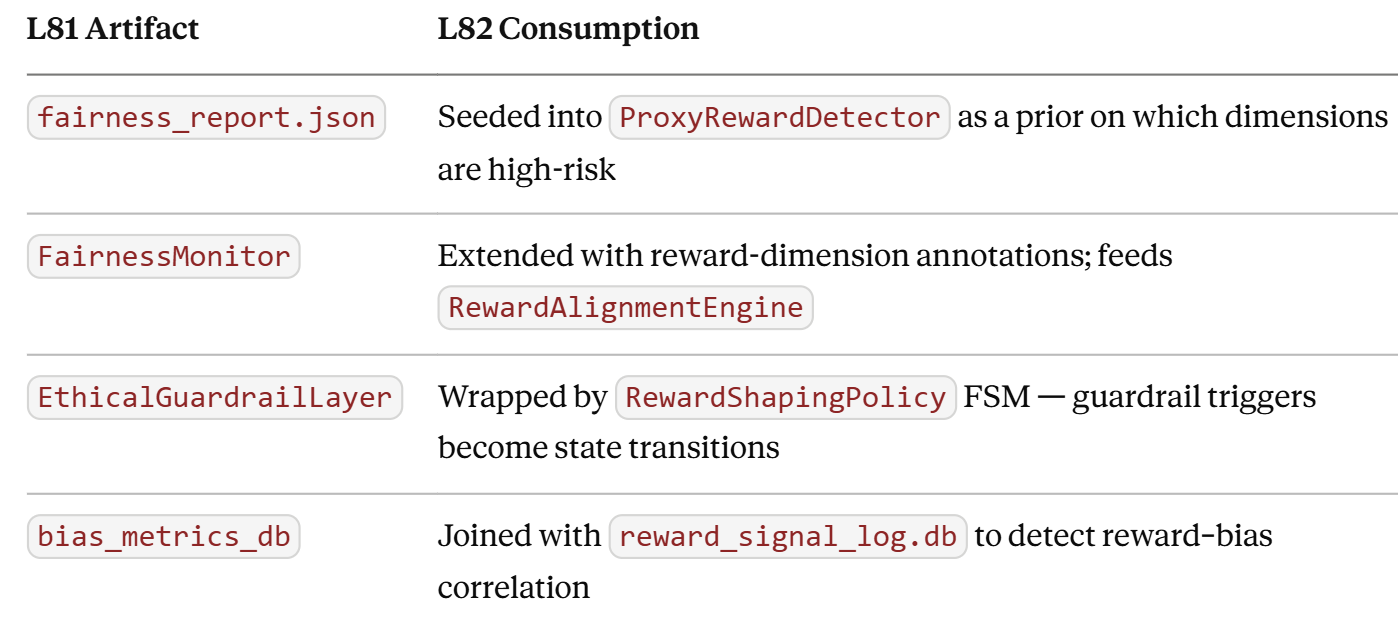
Connection to L81 (Bias Mitigation & Ethical AI): L81 built the FairnessMonitor and EthicalGuardrailLayer — runtime components that evaluate agent outputs for demographic parity and equal opportunity violations. L82 sits one level deeper in the stack: it asks why a biased output was produced in the first place. The answer is almost always misaligned reward. An agent that learned to optimize a proxy metric (e.g., task-completion speed) may have internalized a reward signal that inadvertently penalizes thoroughness for certain user groups. The fairness_report.json produced by L81 becomes a training signal for L82’s ProxyRewardDetector — if fairness violations cluster around a specific reward dimension, that dimension is a proxy candidate.
Enables L83 (Auditing & Red Teaming): The ConstraintViolationRegistry and OptimizationAuditTrail built here are the primary artifacts consumed by L83’s red-team harness. Red teamers need a map of where the reward landscape is exploitable before they can construct adversarial prompts. L82 hands them exactly that.
Architecture Context
Place in the 90-lesson VAIA path
We are at lesson 82 of 90 — deep inside Module 8 (Enterprise Safety & Alignment). The curriculum arc is: Fairness (L80) → Bias Mitigation (L81) → Reward Alignment (L82) → Red Teaming (L83). This progression mirrors how enterprise AI safety actually works: you measure fairness first, then trace fairness failures to their source (biased optimization), then harden the reward surface against adversarial exploitation.
Module 8’s objective is to transform a high-performing VAIA into a trustworthy one — a system that remains aligned under distribution shift, adversarial pressure, and long deployment horizons. Reward alignment is the mechanical heart of that objective.
Integration with L81 components