Lesson 87: Team Collaboration & Version Control for VAIA Systems
Highlights
What We Build
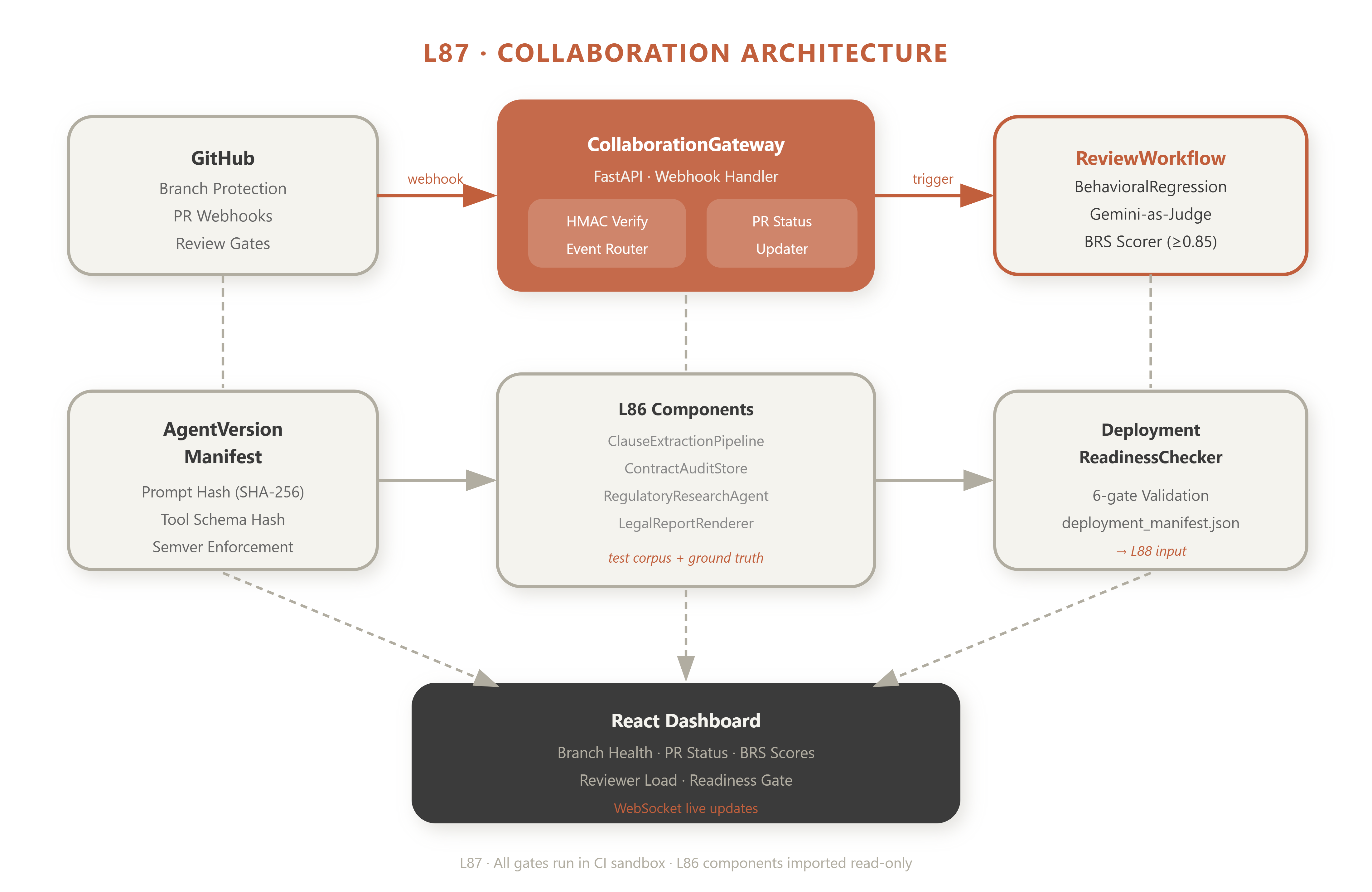
A Git-native collaboration layer purpose-built for multi-agent AI repositories, enforcing branch protection rules, semantic versioning, and PR review gates specific to LLM-powered code.
A
ReviewWorkflowEnginethat runs automated AI-specific checks on every pull request: prompt drift detection, agent behavioral regression via Gemini-as-judge, and dependency compatibility checks.A
CollaborationGatewayFastAPI service that bridges GitHub webhooks to the agent runtime, triggering re-validation ofClauseExtractionPipelineandRegulatoryResearchAgenton every merge.An
AgentVersionManifest— a structured YAML/JSON artifact that pins every agent’s prompt hash, tool schema version, and model config, enabling deterministic rollback.A React dashboard for visualizing branch health, PR review status, reviewer assignment load, and agent behavioral regression scores across the team.
Connection to L86 (Legal Agents) L86 delivered five production components:
LegalAgentBase,ClauseExtractionPipeline,ContractAuditStore,RegulatoryResearchAgent, andLegalReportRenderer. These components are immediately realistic targets for team collaboration — legal AI systems are precisely the kind of high-stakes code that cannot ship without structured review. In L87, all five are imported and placed under formal version control governance: their prompt configs are hashed into theAgentVersionManifest, their outputs become the ground truth for behavioral regression tests, and their audit store schema is versioned for safe schema migration across branches.
Enables L88 (Production Deployment) L88 requires a deployment-ready artifact: an immutable, versioned, fully-reviewed codebase with zero unresolved review comments. L87 produces exactly that — the
DeploymentReadinessCheckervalidates branch protection compliance, confirms all PR checks passed, and emits a signeddeployment_manifest.jsonconsumed by L88’s Docker build pipeline.
Architecture Context
At lesson 87 of 90, the curriculum has traversed the full VAIA stack: foundations → RAG → multi-agent orchestration → MLOps → responsible AI → vertical specialization. The final arc (L87–L90) is about hardening and handing off. L87 occupies a critical seam: it takes the vertical agent work from Module 9 and makes it team-portable and production-gate-compliant.
The architectural insight here is subtle but decisive: version control for AI systems is not the same as version control for traditional software. A git diff on a Python function tells you everything. A git diff on a prompt template or a RAG retrieval config tells you almost nothing about behavioral change. This is the problem L87 solves.
The integration point with prior lessons is the ContractAuditStore from L86 — its append-only hash-chained structure naturally provides behavioral ground truth. When a PR modifies ClauseExtractionPipeline, the ReviewWorkflowEngine re-runs the pipeline against ten canonical contracts from the audit store and compares outputs via Gemini-as-judge. Regression = blocked merge.