Highlights
What we build:
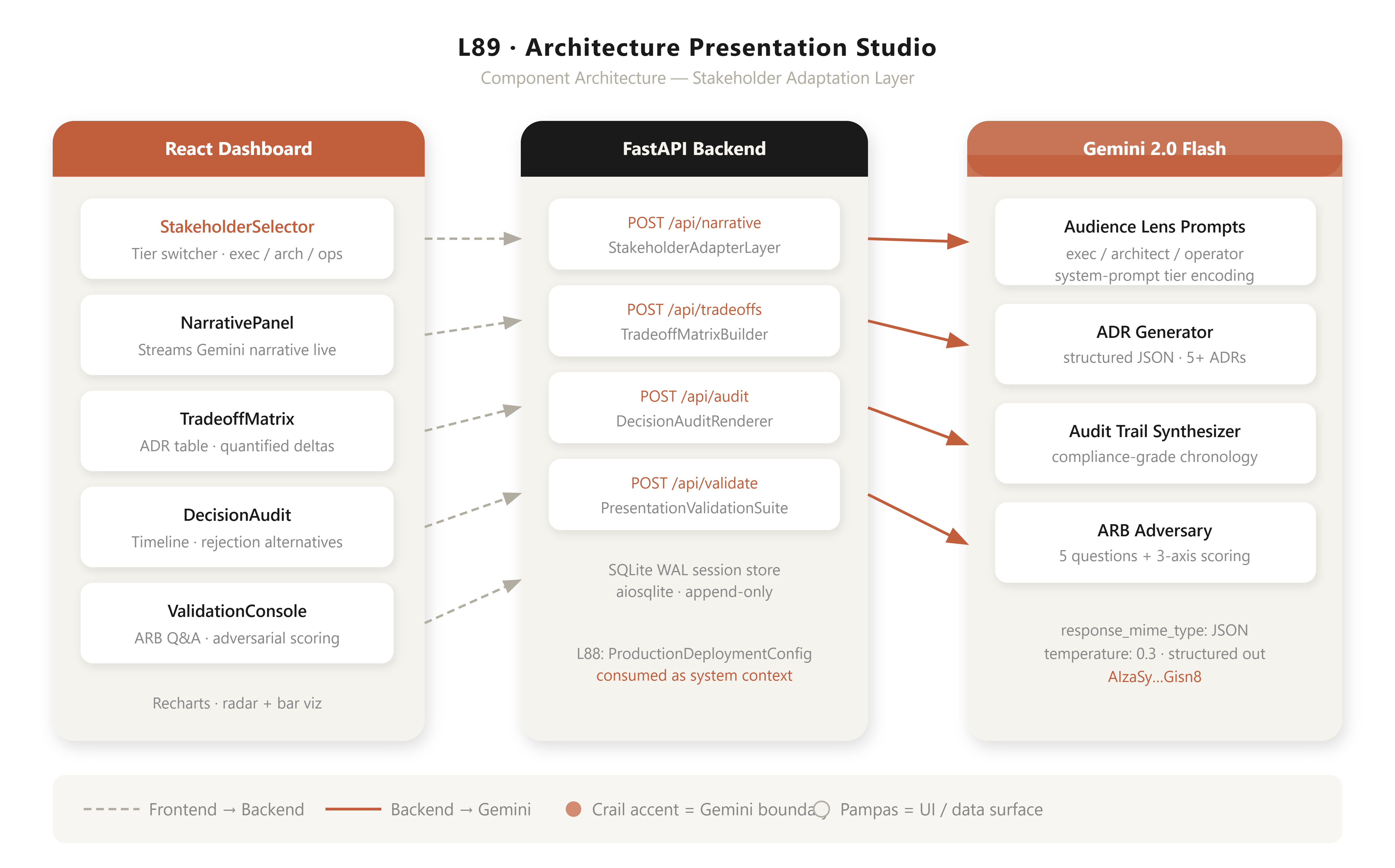
A StakeholderAdapterLayer that rewrites the same architecture story at three audience tiers — executive, architect, operator — using Gemini 2.0 Flash as the translation engine
A TradeoffMatrixBuilder that generates quantified ADRs (Architecture Decision Records) from structured system context, producing shareable Markdown artifacts
A DecisionAuditRenderer that surfaces every non-obvious design choice with its rejection alternatives, forming an auditable narrative thread
A PresentationValidationSuite that red-teams your own slide deck — generating likely adversarial questions and scoring draft answers for completeness and defensibility
A React dashboard (ArchitecturePresentationStudio) wiring all four into a single rehearsal environment with live Gemini critique
Connection to L88 (Deployment to Production Environments): L88 finalized ProductionDeploymentConfig, SecurityHardeningLayer, and ScalingOrchestrator. This lesson treats those artifacts as the subject matter of a presentation — we don’t repeat or re-implement them, we learn to narrate and defend them to a boardroom, an architecture review board, and an on-call SRE team simultaneously.
Enables L90 (Capstone Project: VAIA Scoping): The ArchitectureNarrativeEngine and TradeoffMatrixBuilder built here become the scaffolding for writing the Capstone proposal. L90 requires a formal architecture diagram and technical plan — both will be produced using the ADR pipeline authored now.
Architecture Context
At lesson 89 of 90 you have built, tested, and deployed a production-grade Vertical AI Agent system. The architecture is real. The challenge now is communication ownership: the ability to stand in front of a CTO, a security review board, or a skeptical SRE and narrate your decisions with precision, defend every tradeoff with evidence, and adapt the same underlying system story to radically different audiences in real time.
This is not a soft-skills elective. In enterprise settings, the gap between a technically correct system and an approved, funded, and trusted system is almost always a presentation gap. Systems die in architecture review boards because engineers can’t explain why they made a specific choice — not because the choice was wrong.
The ArchitectureNarrativeEngine introduced here is a programmatic layer, not a slide template. It ingests your system’s structured context (component graph, tradeoff log, deployment config from L88) and emits audience-calibrated narratives via Gemini. The PresentationValidationSuite then attacks those narratives with adversarial questions drawn from real review-board patterns.
Integration with L88 components:
ProductionDeploymentConfig→ input toTradeoffMatrixBuilder(exposes scaling decisions to narrate)SecurityHardeningLayer→ input toDecisionAuditRenderer(surfaces security choices as defensible ADRs)DockerComposeProduction→ context injected intoStakeholderAdapterLayerfor operator-tier narrative