Highlights
Three focused sprint lessons converting the L90 CapstoneProjectManifest into a running production system. By the end of L93 you will have shipped:
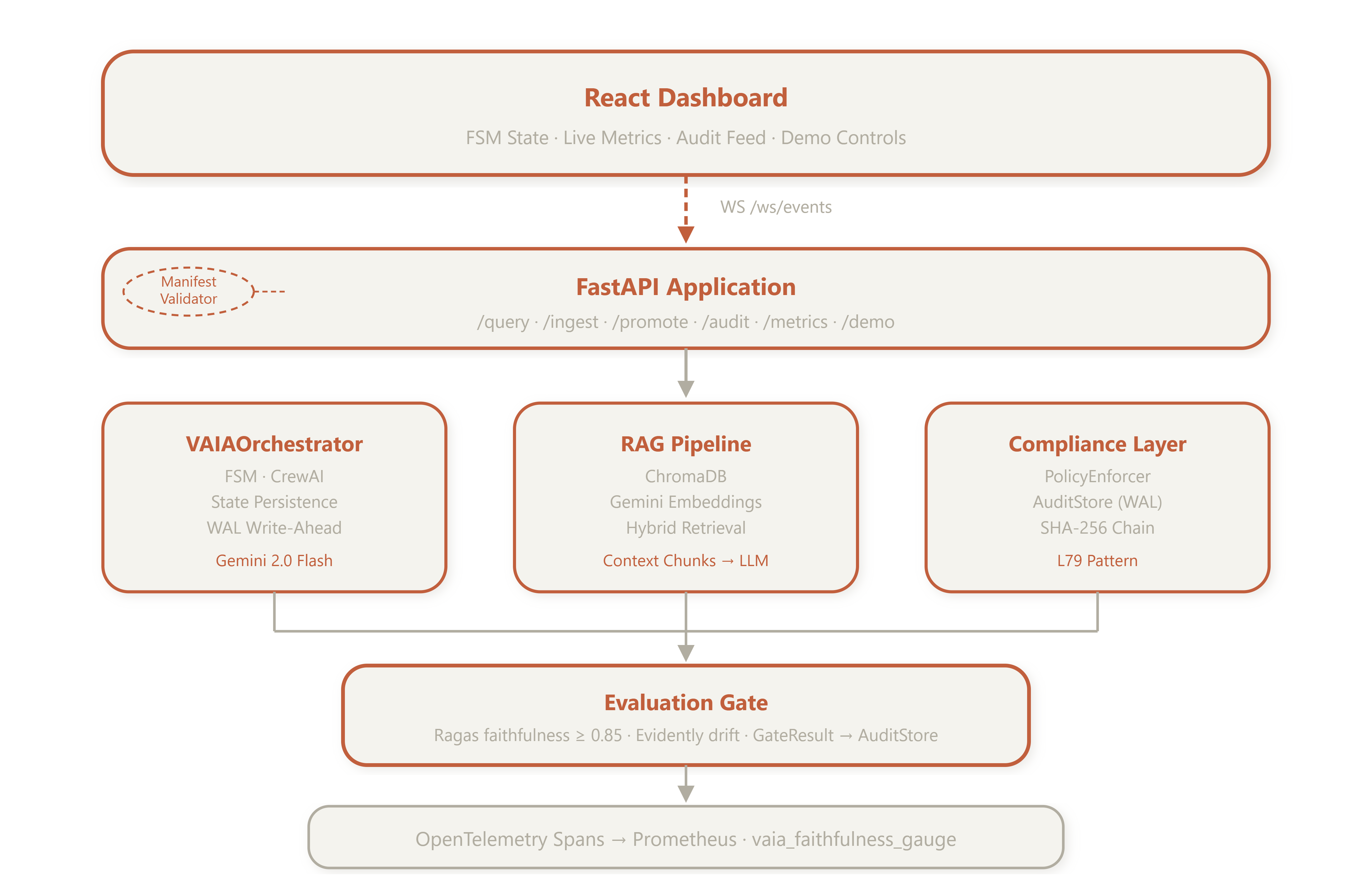
VAIAOrchestrator: a finite-state-machine agent backed by CrewAI, wired to a Gemini 2.0 Flash reasoning core
RAG Pipeline: ChromaDB vector store with Gemini embedding ingestion, retrieval, and faithfulness gating
Compliance Audit Store: append-only SQLite WAL with SHA-256 hash-chaining (the L79 pattern applied end-to-end)
Evaluation Gate: Ragas + Evidently metrics gating every promotion; system self-blocks if faithfulness drops below 0.85
Live Dashboard: React 18 / Vite frontend consuming WebSocket streams from FastAPI, showing FSM state, metrics, and audit events in real time
Connection to L90
L90 produced a
CapstoneProjectManifest— a hash-chained JSON document containing weighted feasibility scores, a chosen topology template, and aRequirementsTraceabilityMatrixlinking 89 lessons’ exported components. L91-L93 treats that manifest as a bootstrap contract:setup.shreads the manifest SHA-256 hash on startup and refuses to proceed if the chain is broken. Every architectural decision made here traces back to a manifest entry.
Enables L94-L95
L94-L95 requires a live, defensible system. Everything built here is instrumented to generate the submission artifact set: audit trail export, metric report, ADR corpus, and a
LiveDemoEndpointthe panel can hit during the defense.
Architecture Context
L91-L93 sits at the integration apex of the 90-lesson path. Earlier modules supplied individual components:
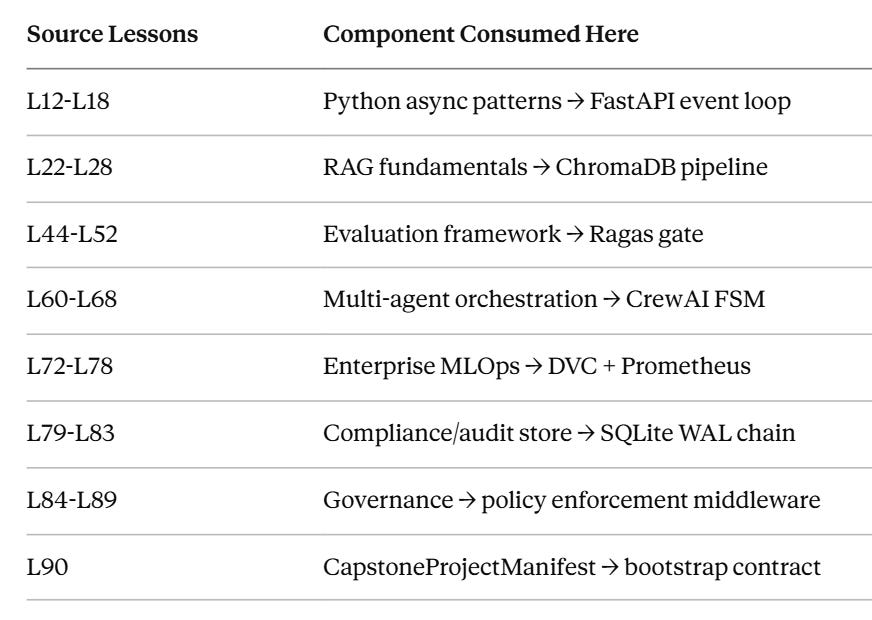
The topology chosen from L90’s five templates drives the wiring in this lesson. The reference implementation uses Template 3: RAG-Augmented Reasoning Agent — single orchestrator, retrieval sub-agent, compliance middleware, evaluation gate, observability sidecar.